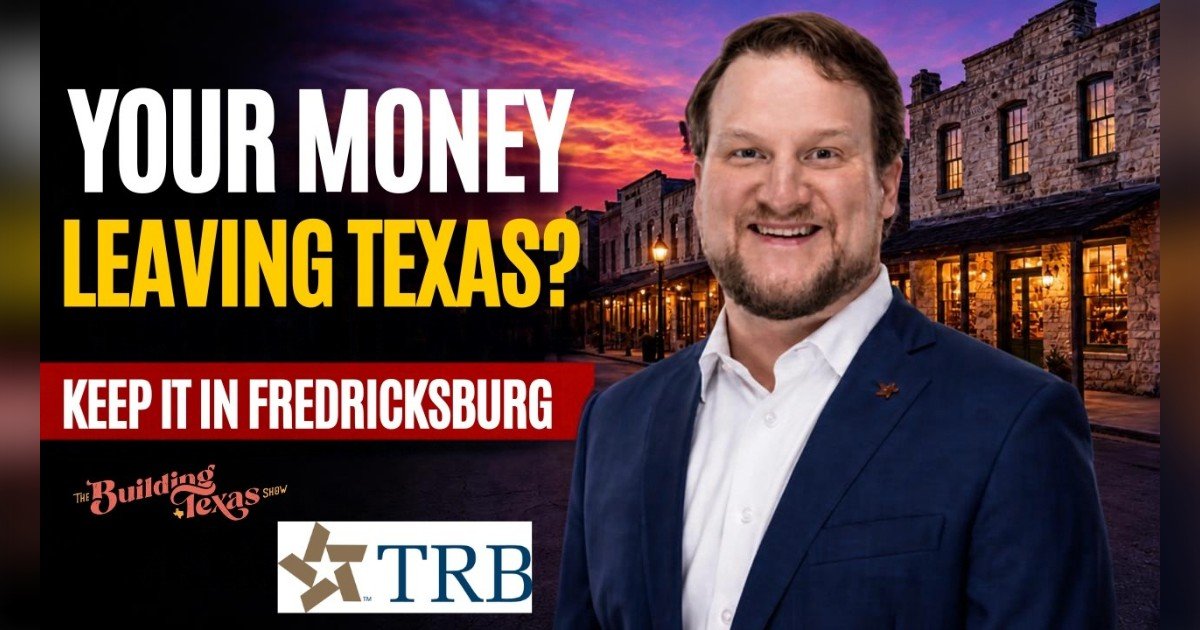
When Hill Country residents and small-business owners deposit money into national banks, those funds are not recycled into local loans or community projects, according to John Wells, Market President for Texas Regional Bank in Fredericksburg. Wells made the argument on the latest episode of The Building Texas Show, hosted by Justin McKenzie, which lands October 21, 2026, and examines where local deposits actually go.
Wells, who began his career on the frontline at Chase before stints at the former Compass Bank and a five-year run building Texas Regional Bank’s Fredericksburg market, drew a sharp line between national and community institutions. “Nothing against the big banks, the big national banks, but all that money, all the deposits that are going into those banks are going straight to New York,” he said. “They are going to these giant loans in Chicago and New York and L.A., and they’re not being reinvested here in the community.” He contrasted that with community lenders like Texas Regional Bank and Security State Bank, which he says put earnings back to work locally.
The implications extend beyond banking philosophy. Wells credits Dan Kemp and David Pedragon of Security State Bank as servant leaders who helped fund the Fredericksburg High School incubator, and he points to Little League jerseys stamped with hometown bank logos as a visible test of who actually backs the community. The episode, titled Why Your Money Might Be Leaving Texas (And Where It Goes), also tracks Fredericksburg’s rapid evolution into a national destination without losing its Texas identity. Topic threads include the arrival of the Waldorf Astoria and what it says about tourism-led growth beyond peaches, antiques, and German heritage; relationship banking versus rate shopping, and why the best operators keep an attorney, a CPA, and a banker on speed dial; and Fredericksburg ISD’s incubator and CTE programs, the Chamber’s role under Jim McCulla, and the fight against Hill Country brain drain.
Wells and McKenzie also discuss his wife’s work as sales director at Insight Gallery, the influx of remote executives from Austin and San Francisco, and the housing-affordability gap that still constrains young families. Wells, incoming chair of the Fredericksburg Chamber of Commerce, previews student pitches heading to the Texas Venture Fest in Mason.
The conversation matters because it puts a local face on a national trend: as community banks compete with larger institutions, the question of where deposits are deployed has direct consequences for small-business lending, workforce development, and the ability of Hill Country towns to retain young talent. For savers and operators, the episode frames banking choices not as a matter of rates alone but as a decision about whether local capital circulates at home or exits the region.