For years, businesses have been told to buy the best tool for each job and integrate them. But according to idhubs, that approach is fundamentally broken, especially as artificial intelligence evolves from simple chatbots to autonomous agents that execute multi-step workflows. In a recent interview with The Building Texas Show, idhubs Founder and CEO/CTO Rojit Sorokhaibam and Chief Growth Officer Brandon Fears explained why the integration model fails under AI and how their platform aims to replace the traditional software stack.
The problem, as Fears described, is chaos that businesses didn't choose. A company under 200 employees typically runs about 42 separate applications. A simple task like converting a prospect, sending an onboarding agreement, billing a deposit, and assigning a kickoff task requires touching five different apps, each with its own login. Sorokhaibam added that these systems don't agree with each other, leading to data discrepancies that the industry has sold as "best of breed" for a decade. But with AI agents, siloed data becomes a wall. "An agent cannot intelligently complete a workflow if it has to reach across five databases that only pretend to talk through brittle webhooks," Sorokhaibam said. They call this "context blindness."
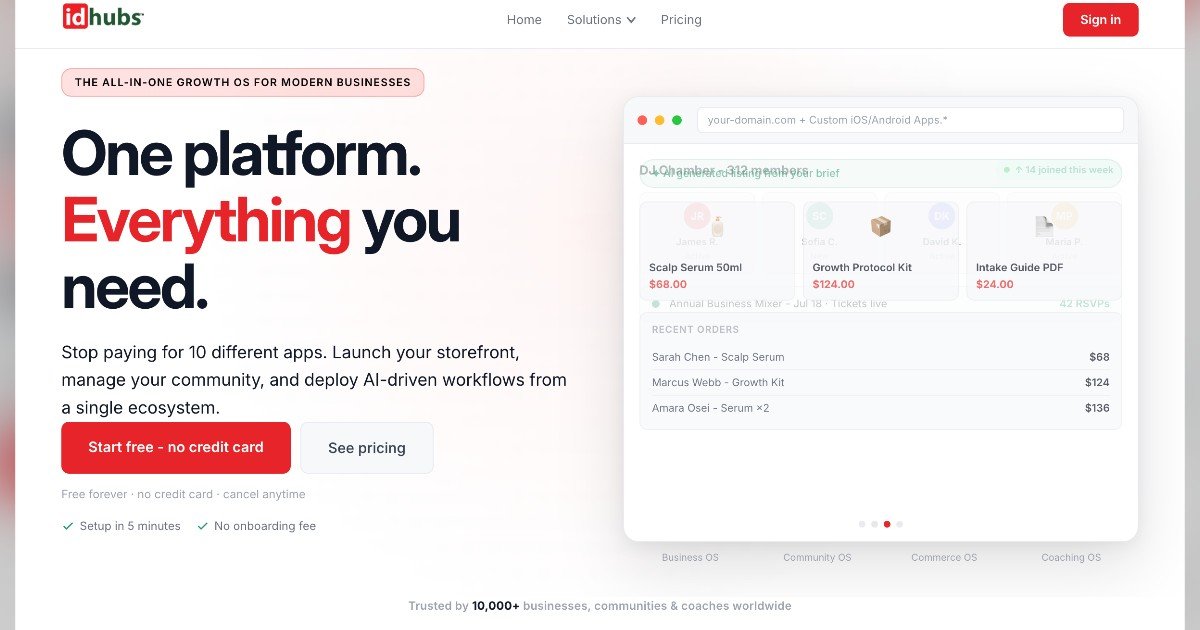
idhubs claims to solve this with a natively unified operating system that includes CRM, e-commerce, community, invoicing, and AI on a single shared data layer. Unlike integrated systems, which are two databases that learned to talk, native means there was only ever one. This unification enables AI agents to execute complex workflows out of the box. For example, in customer success, an AI agent can read a community post, pull billing history, identify a double-charge, auto-draft a credit memo, and route it for approval, all without human intervention.
The platform also includes a white-label community and social commerce layer, allowing organizations to own their audience and data. "When you build your community on a third-party social platform, you rent your audience; you don't own the data," Fears said. With idhubs, community data lives natively beside CRM and commerce data, creating a closed loop.
Addressing security concerns, Sorokhaibam explained that idhubs runs on a permissioned, private Hyperledger Fabric network. This provides decentralization and immutability within the organization's walls, neutralizing single-point-of-failure risks. He noted that it's not resource-intensive because heavy payloads are stored off-chain, and the ledger only anchors state changes and audit trails asynchronously.
The company is led by a team with significant experience: Sorokhaibam is a three-time exited CTO, Fears has launched over $2 billion in products, and COO Sav is a 30-year operations leader. They claim a total addressable market of $158 billion and have acquired over 50,000 registered users organically.
Pricing is flat and predictable, based on organizational capacity and transactional volume, not headcount. This avoids per-seat penalties and hidden fees. "You know exactly what your software bill will be in Q4, regardless of whether you hired five people or fifty," Fears said.
Skeptics argue that best-of-breed point solutions offer more depth, but idhubs counters that its modules are deep and API-first, handling complex multi-currency and tax compliance natively. For niche workflows, custom extensions can be built on the unified data layer. Migration, often a barrier, is addressed with automated pipelines for major incumbents like HubSpot, QuickBooks, Salesforce, and Slack, and parallel environments to minimize disruption.
Competing with unified suites like Zoho, Odoo, and HubSpot, idhubs asserts that legacy suites were built as separate apps glued together, so their data layers remain fragmented. "We are natively unified from the ground up on a single data layer," Sorokhaibam said. The Hyperledger security model is enterprise-grade out of the box, which legacy SMB suites lack. For more information, visit idhubs.
The implications are significant. If idhubs succeeds, software could become a silent partner rather than a daily operational burden, freeing human capital for strategy instead of reconciliation. For member organizations, it could turn a siloed directory into a connected economic ecosystem. As Fears put it, "The fix was never one more tool or one more integration. It was always one secure, unified platform."