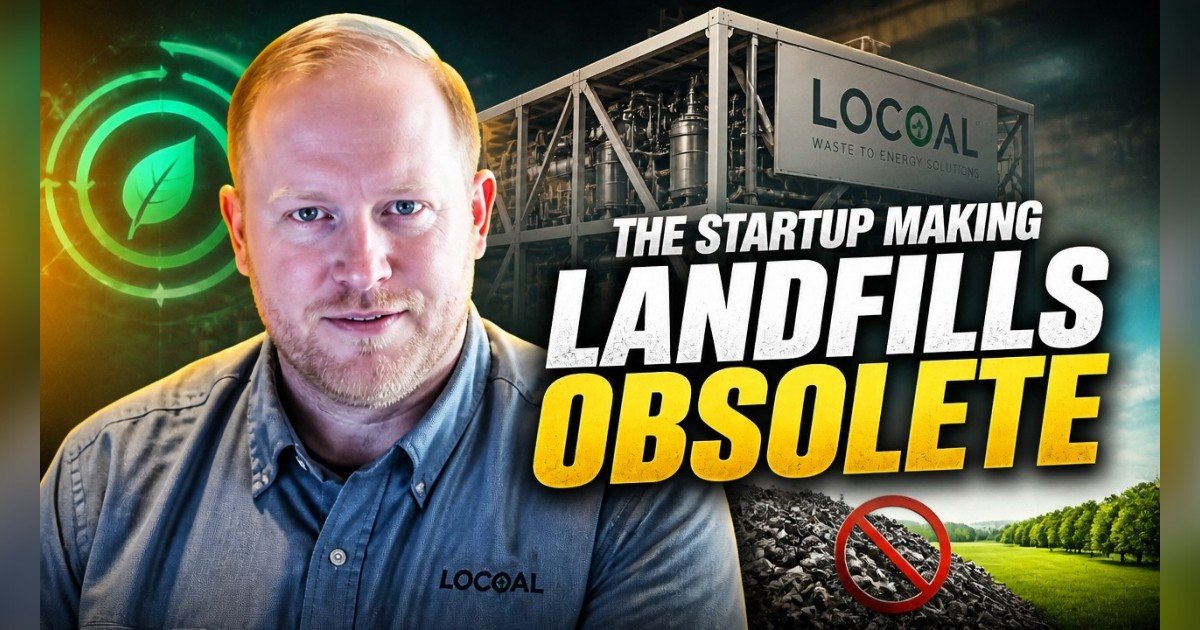
Texas county judges are being asked to rethink the waste piles that accumulate out of public view. On a December 2025 episode of The Building Texas Show, LOCOAL co-founder and CEO Miles Murray made a direct pitch to local officials: turn mulch, storm debris, and old tires into power instead of letting them sit.
Murray said the mulch market is nearly saturated, so most material ends up in large piles that sit for long stretches and become fire hazards. “These become fire hazards … They can be accelerants to very large wildfires that we’ve seen in the last decade,” he said. Fire officials share that concern; the Houston Fire Department’s fire safety standard for wood waste processors states that wood chipping, composting, and mulching operations create a significant fire hazard rated as very high.
LOCOAL developed its waste-to-energy system with support from the U.S. Air Force through the federal Small Business Innovation Research (SBIR) program. Federal SBIR records list Air Force Phase I and Phase II awards to the company, which describes itself as seed-funded by an AFWERX contract. “We developed this technology under the U.S. Air Force Small Business and Innovation Research Program,” Murray said. “Once we’re finished with the commissioning process, we’ll be considered a phase three where you can directly procure our technology as a federal entity.”
The company’s first commercial unit is installed in Houston. The system uses pyrolysis—heating wood waste without oxygen—to produce electricity and a high-purity carbon product, and Murray said LOCOAL is also moving into rubber from tires. The unit is built to travel: “It’s a 50-foot system that is basically your maximum flatbed sized module that can be transported,” Murray said. “You could show up with eight flatbed trucks and within a couple of weeks you’ve got yourself a power plant that can move about 50 tons of material per system per day.”
Murray framed the work as a way to make landfills obsolete. “So what would normally be a cost to somebody, we’ve turned into a revenue stream,” he said. He also addressed skepticism about carbon markets, arguing that LOCOAL tracks its carbon from where the waste starts to where it ends up. “When you hear about things like carbon credits and people are like that’s a bunch of hocus pocus … it is whenever you’re measuring it from a helicopter over the Amazon,” he said.
The implications extend beyond waste management. For county judges, the technology offers a potential revenue stream from material that currently poses fire risk and disposal costs. For fire officials, reducing pile accumulation could lower wildfire accelerants. And for the military, the Air Force’s investment signals a path toward commercial procurement of a system that can be deployed quickly. Murray’s pitch is part of a broader effort to convince local leaders that waste is not just a liability but an energy resource.
The conversation marks Murray’s third appearance on The Building Texas Show, following episodes in 2023 and 2024. County leaders and others managing waste piles can find more Texas stories at buildingtexasshow.com.