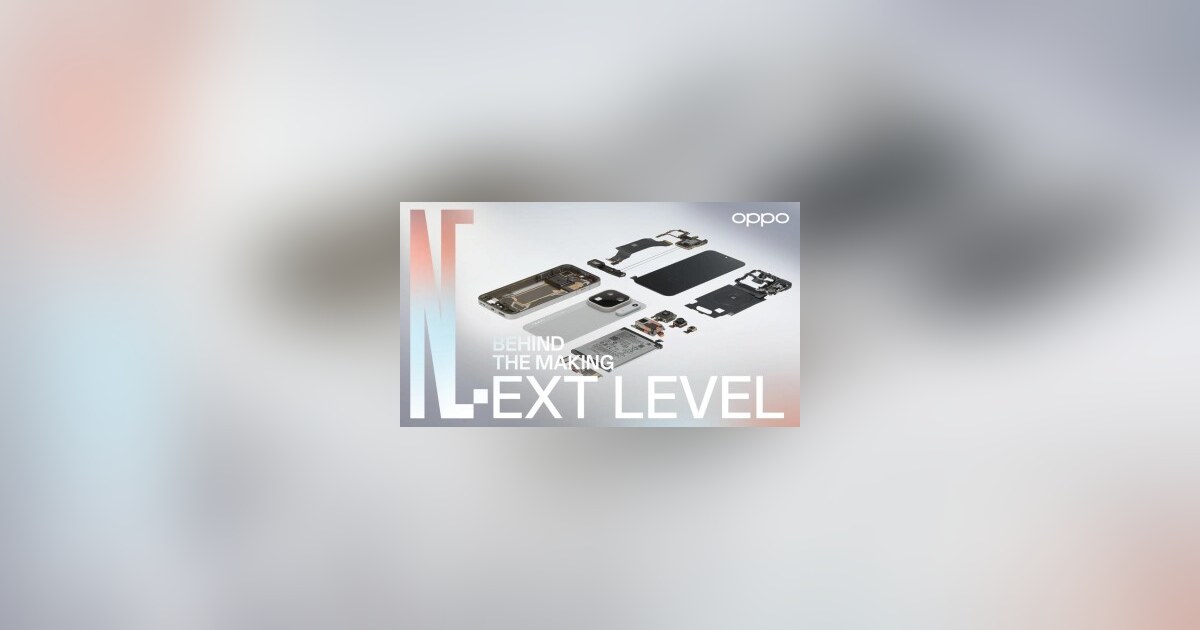
OPPO has offered an inside look at the development, testing, and manufacturing processes behind its new Find X10 Series, positioning the flagship lineup as a proof point for how the company turns quality commitments into products at global scale. The initiative, dubbed the Next Level of Making, matters because it signals a shift from marketing specifications to transparency about the systems that underpin reliability, imaging performance, and AI capabilities—areas where consumer trust is increasingly hard to earn.
At the core of the effort is OPPO's Clean and Sophisticated design language, exemplified by the One-Piece Sculpted Glass design on the Find X10 Series. The glass back rises gradually toward the camera module, creating a three-level transition that softens the camera's visual impact and establishes a clear hierarchy. On the Luna White edition of the Find X10 Pro Max, OPPO adds a fluted texture along the camera edge, crafted through high-precision CNC engraving as a nod to classic lens focus rings. A two-tone woven pattern, recreated within the matte glass surface, remains subtle until light hits the phone at an angle. According to OPPO, the Luna White colorway alone required more than 40 rounds of fine-tuning, while a single rear-panel pattern needed over 10 rounds of refinement across multi-stage precision treatments. These details matter because they illustrate how design consistency is engineered rather than incidental.
The camera system reflects a similar rigor. Building on its co-development with Hasselblad that began in 2022, OPPO equips the Find X10 Series with three Hasselblad modes—Master Mode, Hi-Res Mode, and Portrait Mode—while the next-generation LUMO True Image Engine handles natural color, fine detail, and lifelike tone. The engine operates across three architectures: the LUMO Natural Tone Engine for linear tonal rendering, the LUMO True Color Engine for accurate color reproduction using a 24-channel multispectral sensor, and the LUMO Hyper Pixel Engine for continuous 26MP output by default and full-resolution 200MP photos in Hi-Res Mode. OPPO says it tests HDR performance, facial brightness, and skin-tone gradation across 40 lighting conditions, and evaluates color against 140 different colors rather than the industry-standard 24-color chart. Real-world simulations, including a dedicated concert stage setup and multi-axis robotic arms to mimic hand movement, further validate stabilization and zoom performance. The implication is that OPPO is competing on measurable imaging consistency, not just hardware headlines.
On the AI front, ColorOS 17 introduces system-level intelligence supported by a dedicated security framework. The updated AI Mind Pilot adds an Agent Mode powered by the third-party AI agent Manus, which operates on-device across photos and files to understand complex context and execute multi-step workflows. A new AI Photo Agent, backed by OPPO's proprietary Visual-Language Model and six expert image models, interprets visual references and natural-language instructions to make edits users actually want. Behind these features, OPPO operates nine Internet Data Centers across six regions with 99.99% availability, and its AI Security Framework safeguards user data throughout the AI lifecycle, including through a Private Computing Cloud developed with Google. This matters because AI features are only as valuable as the infrastructure and privacy controls that support them.
Manufacturing scale underpins the entire effort. OPPO operates nine smart manufacturing centers globally, spanning China, India, Indonesia, Egypt, Turkey, Brazil, Pakistan, and Bangladesh, with over 95% of Surface Mount Technology lines and an average of 85% of final assembly lines fully automated. The Chang'an Intelligent Manufacturing Center in China uses more than 300 automated testing stations and can ship up to 7,200 finished Find X10 Pro Max devices daily. As reported by Media OutReach Newswire, OPPO's integrated approach—from design and imaging to AI and production—is intended to deliver exceptional quality and consistency worldwide. The broader implication is that OPPO is making a case that its competitive edge lies in the unglamorous, end-to-end control of making, a claim that could reshape how consumers and rivals evaluate flagship phones.